Search Reddit for Google Ads and you’ll find the same posts week after week.
An accounting firm paid an agency to run its ads. About £4,400 later, it had no leads.
A fencing company spent around £5,100. Google reported 50 leads. The owner said not one was real.
Most of them started with the same question. How much do I need to put in?
It’s the question a mate asks me in the pub when he’s thinking about Google Ads. Here’s what I tell him.
Ask a better question
The good and bad thing about Google Ads is that it’s flexible. You could spend £1 a day. You could spend £1,000 a day.
So “how much does it cost?” doesn’t have a useful answer. Ask this instead:
How much do I need to spend to see that it’s working?
Forget being booked out for months, or becoming a millionaire. The aim is enough spend over one to three months to see things moving the right way. Some leads. Some money made. No miracles.
The 10 clicks a day rule
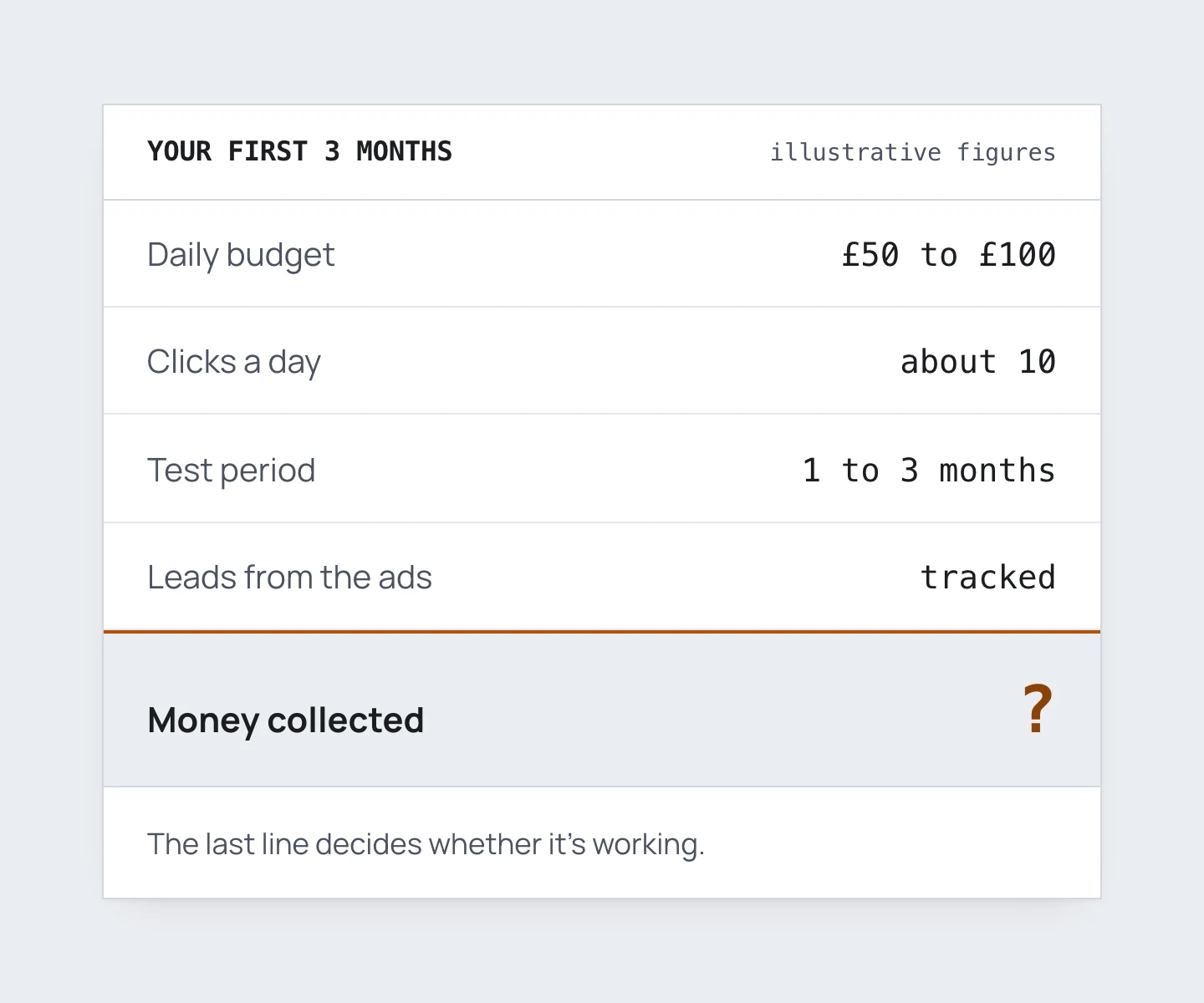
My answer: a budget that buys about 10 clicks a day in your market. Every working day.
Take an electrician in a medium-sized town in England. Not London, not a huge city. That might be £50 to £100 a day.
Ten is a rule of thumb. It gives whoever runs the ads just about enough data. Enough to see what’s moving, what’s working, and what to change.
Why less doesn’t work
Say you can only afford three clicks a day.
It’s like driving a car with the handbrake on. You might be heading towards your destination. But you’ll get there very slowly. And you’ll do a lot of expensive damage on the way.
With 10 clicks a day there’s enough to make decisions. By month one, two or three, you can answer the only question that matters. Is this working for us?
Why more doesn’t work either
Don’t start too big. Paid ads expose the other things that are broken in a business. Things like:
- The phone isn’t answered fast enough
- Missed calls with no call back
- No follow-up system
- A CRM that doesn’t work
- Nobody quite knows what to do with a new lead
Start from zero at £1,000 a day and all of that breaks very quickly.
Running ads is like pouring petrol on a fire. The fire needs to be lit already. Pour it on a damp pile of logs and you waste the petrol. And the money, and the energy.
What to have in place before you spend £1
Some numbers are nice to have. Few small businesses can tell me them on day one:
- Average revenue per job
- Out of 20 calls, how many get a quote
- How many quotes turn into a paid job
If you don’t know them, that’s fine. We go day to day, and you stay plugged in.
Before any of my clients spend a penny, I send over a questionnaire. These are the things on it that have to be answered.
Where you’ll work. Which areas can you serve reliably? Not three hours in traffic for one job.
Your website. Does it look good and work on a phone, not just a desktop? If not, we plan landing pages straight away. Often we’d use dedicated landing pages anyway.
What happens to a lead. Walk me through it. Someone fills in a form. Someone calls. You miss the call. Someone sends a WhatsApp. What happens each time? I’ll pick holes in it as we go.
Why you. What makes you different from your top three to five competitors?
Why people say no. Why do people not go ahead after a call or a quote? Is it price, speed, or trust? Your customers won’t always tell you the truth. But I need to know what you believe, because the ads have to answer it.
Your offer. What are you willing to run? Can you beat competitors on price? Can we run a specific offer they don’t have?
Tracking. Conversion tracking has to work on your website. If the ads went live tomorrow, we’d need to see the basic calls and form fills.
Expectations. Can the business spend a full month’s budget and see nothing back? If it can’t, you’re gambling. You’d be better off doing the lottery or a bet on the horses.
What management costs on top
The ad spend isn’t the only cost. If someone runs the ads for you, count their fee in the result too.
Judge it quarter to quarter, or six months to six months. Not month to month.
And remember what the fee buys back. You’re not running the ads, so you save headaches and headspace. And a few hours a week, at least.
Should you run it yourself?
Only if you’re committed. That means paid courses, consulting sessions and learning on your own account. Accept that results won’t be your best while you learn.
You know your business better than anyone. That’s a strength and a weakness.
If you won’t invest in your own learning, don’t run it yourself. Get someone to do it.
What you get at each price
These are rough UK figures for management, on top of the ad spend. The US is usually more expensive.
Under £300 to £400 a month. Expect set and forget. They’ll set it up, but won’t learn your industry, watch your competitors or manage it properly. It might work. It might not.
£400 to £800 a month. Usually a freelancer or small agency, and they probably have your interests at heart. This usually covers the ads, with landing pages and tracking costing extra. They’ll be running a good number of accounts, so don’t expect a dedicated full-time person.
£800 to £1,300 a month. A good boutique agency or freelancer who knows your industry, or will learn it. This should cover more than the ads. Think landing pages and attribution. Plus an eye on how your SEO compares with paid.
That last part matters. I’ve had clients whose SEO was already strong. When they wanted to raise their ad budget, I told them to hold the ads steady. Their extra money would do more in SEO for six months. I only knew because I track their rankings, organic leads and organic revenue.
£1,300 to £2,000 a month. A fuller service. Your whole website managed, plus some SEO: blog posts and technical work. Multiple channels, and really good reporting. At this price you should expect strong returns, or you’re losing money fast.
£2,000 to £5,000+ a month. Agencies built for big companies with big budgets and lots of moving parts. A nationwide firm with many locations might need one. A local trade business usually doesn’t.
This is the mismatch I see most. The wrong type of business hires the wrong type of agency.
Nike and Adidas aren’t using a small freelancer, for a reason. And Bob’s Plumbing shouldn’t hire an agency with a fancy office and a team of 12. Their coffee machine probably cost more than a freelancer charges a month to manage your ads.
A local business needs someone who understands it and gets their hands dirty. Someone who asks tough questions. Someone technical enough to connect your CRM, Google Ads, call tracking and attribution.
After three months: is it working?
First, ask whoever runs your ads to show you the data. You want leads from calls and forms that tie back to the ads. Not from referrals, SEO or anywhere else.
Then work through it:
- How many of those leads were good quality?
- How many got a quote?
- How many turned into paid jobs?
- How much money did you collect?
That last one is the headline. What money have the ads brought in over three months?
Most agencies and most owners don’t connect the dots. They’ll say, “Well, we’ve been really busy.” Fine, but did that come from the ads? If you can’t prove the whole story, you don’t know. You’re guessing.
If the ads brought in nothing at all, here’s what’s usually wrong when Google Ads gets no leads.
Lead tracking is how you prove it. For one pest control client, Google Ads tracked around £45,000 of revenue in the first year.
If that data doesn’t exist, look at the account itself:
- Are you getting a decent number of clicks?
- Is the full £50 to £100 a day being spent?
- Are the search terms any good?
- Are people seeing the right ad and landing page for what they searched?
- How many search terms should have been blocked?
An outside Google Ads audit will answer those quickly if you’re not sure.
”Ads cost £4,500 and brought in £4,000 of work”
On the surface, I’d say keep going.
There’s nearly always something to tighten that turns a small loss into a profit. And in trades, the next lead could be a big one. A commercial job. A landlord with ten houses. You just don’t know.
So look at the waste first. Search terms, competition, ad copy. If nothing looks like a red flag, you might just need more data. That’s fine, as long as the business can stomach being £500 down.
Then look at what happens after the click. How many visitors become leads? How many leads become quotes?
Any improvement there works on every lead you get. Paid ads, SEO, referrals and existing customers too.
I wouldn’t double the budget. I wouldn’t do nothing either. If the account looks decent, give it another three months.
When Google Ads isn’t for you
Sometimes I’d tell my mate not to do it, or not yet.
You can’t afford a month with nothing back. If losing one month’s spend would put you in real financial trouble, don’t start. We’d be gambling with your future.
You won’t change anything on your side. Maybe you need to follow up faster. Maybe you need a free quote or a different offer. Say you won’t change, and three months have lost money. If I can’t find quick wins in the account, stop. Otherwise we’ll have the same annoying conversation every three months.
You’re up against giants. Say you only want commercial jobs in central London. Your competitors have huge budgets, slick websites and big marketing teams. They change offers quickly and have a row of people answering the phones. A small local business will struggle there. Try a different area outside the big city instead. Go after residential work and leave the commercial jobs.
It’s just a bit extra. Some owners want to let it run and never look at what could improve. That won’t work. That goes for the ads and for the business.
If none of those sound like you, Google Ads can work for you. If you’d like someone to run it, see how I handle Google Ads management.