
Plenty of landing pages promise a fast callback. This one I built for a B2B industrial company says 2 hours.
The promise works because it is specific. Not “we’ll be in touch soon”, but a named person, their job title, their face, and a number of minutes. The visitor knows who is about to ring them and roughly when, which is a far harder thing to skim past than a bare form.
It also creates a dependency. That named person has to actually receive the lead: on site, in a meeting, in a van, nowhere near an inbox. Put a response time on the page and “somebody will pick it up eventually” stops being good enough.
Keeping that promise usually rests on someone having email open. So I send the lead to Telegram as well. It arrives as a phone notification the whole group sees at once.
It takes about ten minutes to set up. It runs on a few Make credits a month.
How it is wired
The form posts into a Make scenario, which was already sending the email. One extra step posts the same lead into a Telegram group. The group is created with a bot through BotFather.
The group holds me and the client. They add whichever sales people or CSRs they want. Nobody has to forward anything.
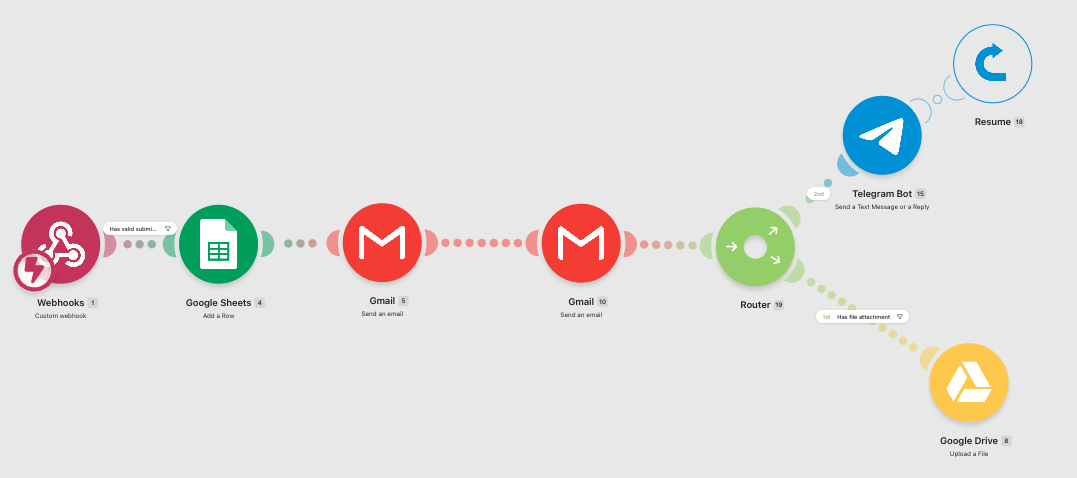
It does not have to be Make, and it does not have to be Zapier. Anything that can make an HTTP request to the Telegram Bot API will do, including code.
This site is the version with no automation tool in it at all. Netlify catches the form submission, and a small serverless function fires on that event and calls the Telegram API directly. The bot token and the group ID live in environment variables. Same result, nothing to pay per run, but you are looking after a function instead of clicking through a builder. Pick whichever one you will still understand in a year.
What the message says
It opens with the instruction, then every field from the form:
New lead received. Please reach out to them within 120 minutes.
- Name, company, email, phone
- Whatever qualifying fields the form asks for
- Project details
- A link to any file they uploaded
The phone number is tappable, so whoever sees it first can call from the notification. Telegram timestamps every message. You can see when the lead landed and when somebody picked it up.
What I leave out: the keyword, the GCLID, the tracking data. That comes to me. Putting it in the group would bury the part the client actually needs.
What goes wrong
A muted group, or notifications turned off. Then you have replaced email with something quieter.
The alert lost among a hundred others. This is the real risk, and it is a habit problem rather than a technical one.
Two things help. Give Telegram its own distinct sound so it does not blend in. And run the desktop app, so enquiries get caught at a computer too.
I keep almost every other notification switched off. That is the only reason the ones I leave on still mean anything.
Worth doing if
You promise a response time anywhere on your site. Or your leads land in a shared inbox, and a shared inbox is nobody’s inbox once everybody is busy.