Everyone assumes their competitors are adding new pages to their website constantly. Usually they are not. I have opened accounts where the rival everybody was worried about had not put up a single new page in six months.
You cannot tell without a record, because nobody checks a sitemap by hand every week. So I built something that does.
What it is
A Google Sheet with a script bound to it. Once a week it reads any number of competitor sitemaps, compares them to last week, and logs what was added, removed and genuinely modified — alongside how many new pages you put up in the same week. It emails you only when something moves.
Setup is a copy of the sheet, your competitors’ sitemap URLs in the Setup tab, and two clicks to authorise it and install the weekly trigger.
What it found on a real account
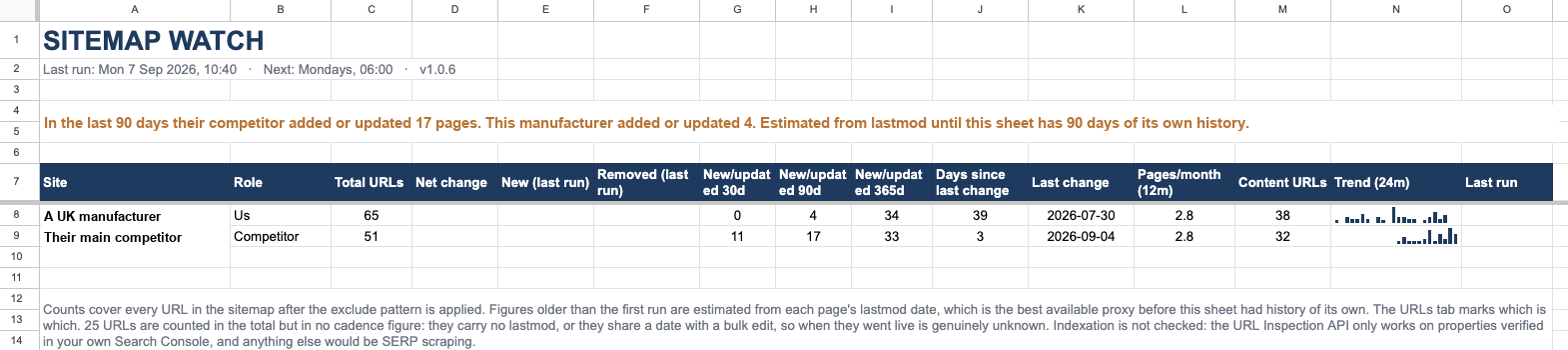
A UK industrial manufacturer against their main competitor:
| The manufacturer | The competitor | |
|---|---|---|
| URLs in the sitemap | 65 | 51 |
| Blog posts | 4 | 31 |
| Added or updated in 90 days | 4 | 17 |
A smaller website adding new pages four times as often. That is a strategy conversation, and it took one afternoon to be able to prove it rather than assert it.
The bit everyone gets wrong
lastmod is not a publication date. It moves whenever a page is edited. The
first version of this told me the competitor had put up 35 new pages in 90 days.
Eighteen of them were not new at all — they were existing pages that had all
been re-saved on the same day, probably a template change applied across the
site.
So the tool applies three rules:
- A
lastmodshared by a big slice of the site is a bulk edit, logged once, not counted as a burst of new pages - Dates clustered like that at first run are left blank rather than guessed at
- It says “added or updated” until it has ninety days of its own observations, then switches to “new pages published” by itself
There is a fourth that is less interesting and more important: a sitemap that fails to load must never read as “every page removed”. A timeout that wipes the inventory and fires an alarming email is the obvious way this breaks.
What it cannot tell you
Whether any of their pages are indexed. Google’s URL Inspection API only works on properties verified in your own Search Console, so a competitor’s URLs cannot be checked at all. Anything else is scraping the results page.
That matters, because “they published thirty new pages and none of them are indexed” is the conclusion everyone wants, and this tool cannot give it to you. It tells you how many new pages went up and when. You still have to open them and judge them yourself.
Worth doing if
You are producing content and cannot say whether it is enough. One week of data tells you nothing; three months tells you who is actually moving.
If you would rather someone just ran this and told you what it means, get in touch.